MEP Coordination Sydney: The Art of “Building Twice”
In the high-stakes environment of Sydney’s construction sector, margins are tighter than ever. From the CBD to Parramatta, developers and builders are under immense pressure to deliver complex assets on shorter timelines. In this climate, the most expensive phrase you can hear on a job site is, “It doesn’t fit.”
When a main mechanical header clashes with a cable tray, or a fire sprinkler pipe runs exactly where a structural beam is located, the project bleeds money. Work stops. Trades stand idle. Requests for Information (RFIs) pile up. Variations are issued.
At VEC Group (Vanguard Engineering Consultants), we believe the only way to safeguard your margin is to build the project twice: once in the virtual world, and once on site. Through our specialized MEP Coordination Sydney services, we create a digital twin of your project, resolving clashes and validating designs long before the concrete is poured.
What Exactly is MEP Coordination?
MEP Coordination is the spatial orchestration of the building’s active systems: Mechanical, Electrical, and Plumbing (alongside Fire Protection and Structural elements).
Historically, these trades worked in silos. The mechanical engineer designed the HVAC; the electrical engineer designed the power; the hydraulic engineer designed the waste and water. They produced separate 2D drawings, often overlaying them on a light table—or worse, not overlaying them at all.
This legacy approach results in two types of clashes:
-
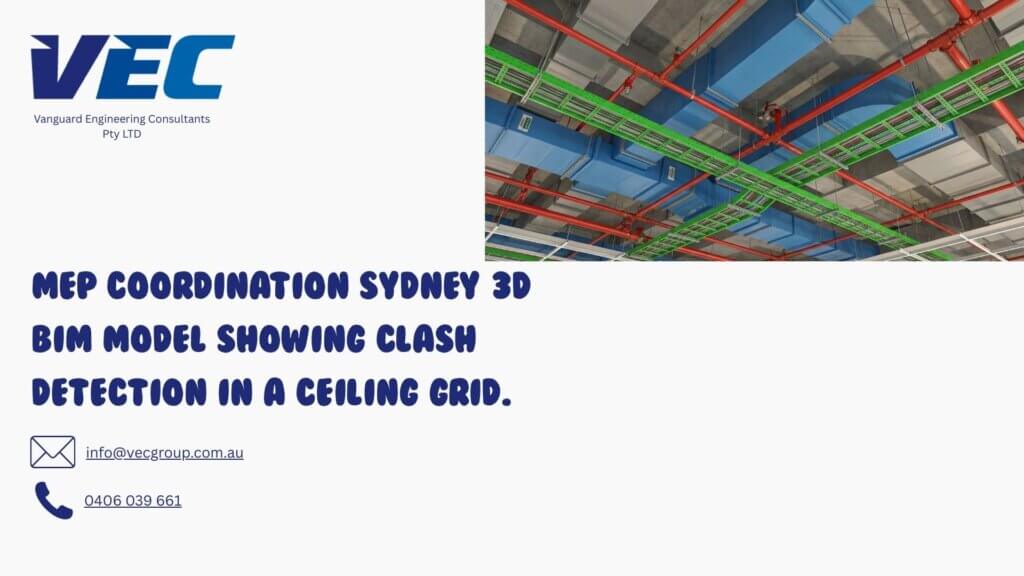
Hard Clashes: Two objects occupying the same physical space (e.g., a pipe running through a duct).
-
Soft Clashes: Objects placed in a way that breaches clearance zones or prevents maintenance (e.g., a cable tray blocking access to a VAV box, or insufficient clearance for high-voltage separation).
Today, using advanced Building Information Modelling (BIM) software like Autodesk Revit and Navisworks, VEC Group combines these disciplines into a single, federated 3D model. We don’t just “draw lines”; we model intelligent components that represent the physical reality of the equipment, ensuring everything fits within the allocated ceiling voids, risers, and plant rooms.
The Hidden Cost of Poor Coordination in NSW
The construction landscape in New South Wales faces unique challenges that make simple 2D drafting insufficient.
1. The “Sydney Space” Premium
Sydney floor space is among the most expensive in the Southern Hemisphere. To maximize Net Lettable Area (NLA), developers compress service zones. Ceiling voids are getting shallower, and plant rooms are shrinking. This leaves zero margin for error. A 50mm conflict in a ceiling void can force a redesign of architectural bulkheads or a compromise on ceiling heights, leading to unhappy clients.
2. The “RFI” Trap
On a traditional project, clashes are discovered by subcontractors during installation. This triggers an RFI (Request for Information) back to the consultant. The turnaround time for an RFI can be days or weeks. Multiply this by 50 clashes, and your project schedule slides by months. Our coordination services aim to reduce services-related RFIs to near zero.
3. Material Waste
Ordering conduit, pipe, and ducting based on uncoordinated drawings often leads to over-ordering or wrong sizing. Accurate coordination allows for precise Bills of Materials (BOM) and pre-fabrication, reducing waste and site clutter.
Our Detailed Process: From Federated Model to Site
We treat coordination as an engineering workflow, not just a drafting exercise. Here is how we execute an MEP Coordination project for our Sydney clients.
Phase 1: Federation and Validation
We begin by gathering the architectural and structural Revit models to establish the “container” of the building. We then import the design models from the various services consultants.
-
Audit: We check the quality of the incoming models. Are the pipes at the correct grade? Are the duct fittings realistic?
-
LOD Assessment: We determine the required Level of Development (LOD). For coordination, we typically aim for LOD 350, where objects are accurate in terms of quantity, size, shape, location, and orientation.
Phase 2: Automated Clash Detection
Using tools like Navisworks or Revizto, we run automated interference checks. We set specific rules based on the project stage:
-
Structure vs. Services: (Critical priority)
-
Mechanical vs. Electrical: (High priority)
-
Gravity Pipes vs. Pressure Pipes: (Gravity always gets right of way)
Phase 3: Resolution Engineering
This is where VEC Group stands out. Many drafting firms simply send you a report saying “There are 500 clashes.” We fix them. Our team of engineers and designers re-routes services in the model. We apply engineering logic—we know that a large HVAC duct is harder to move than a small water pipe, and that gravity sewer lines cannot simply “go up and over” an obstruction. We coordinate the solution, not just the problem.
Phase 4: Documentation and Handovers
Once the model is clash-free, we generate the outputs required for construction:
-
Coordinated Shop Drawings: Fully dimensioned 2D plans for site teams.
-
Penetration Drawings: Precise layouts for builders to leave holes in concrete slabs and walls, avoiding core drilling later.
-
NWD Files: Navisworks files for site supervisors to view on iPads.
Navigating Compliance: It’s More Than Just Geometry
In Australia, a model that fits geometrically might still be illegal electrically or hydraulically. VEC Group ensures your coordinated model respects relevant standards.
AS/NZS 3000 (Wiring Rules): We ensure cable trays maintain mandatory separation distances from water and gas pipes. We also verify that switchboards have the required “open door” escape clearance in plant rooms.
NCC Section J (Energy Efficiency): Ductwork and piping require thermal insulation. A 300mm duct might actually take up 400mm of space once insulation is applied. We model the insulation to ensure the real physical footprint is coordinated.
AS 2419 & AS 2118 (Fire Systems): Fire hydrants and sprinklers have strict placement rules regarding coverage and accessibility. We ensure that other services do not obstruct the spray patterns or access to landing valves.
The ROI of Virtual Construction
For our B2B clients—whether you are a Tier 2 builder or a major services subcontractor—the return on investment for professional MEP Coordination is tangible.
-
Pre-fabrication Opportunities: With a trusted model, you can pre-fabricate risers, spools, and multiservice brackets off-site. This moves labor from a chaotic site to a controlled factory environment, improving safety and speed.
-
Schedule Certainty: When the sheer volume of clashes is removed, the installation program becomes predictable. You can schedule trades with confidence, knowing they won’t block each other.
-
As-Built Value: At handover, you provide the facility manager with an accurate digital asset. This is increasingly becoming a contract requirement for government and top-tier commercial projects.
Why Choose VEC Group?
We are a multidisciplinary engineering consultancy, not a generic “BIM shop.” When you engage VEC Group, you are hiring a team that understands the physics and engineering behind the model.
We integrate our coordination work with our other core competencies:
-
[Electrical Design Services]: We understand voltage drop, cable bend radii, and maximum demand, ensuring our electrical models are electrically sound.
-
[Lighting Design Consultants]: We ensure that lighting fixtures are not just coordinated with ducts, but positioned to deliver the required Lux levels.
-
[Dry Fire Engineering]: We respect the critical nature of life safety systems.
Whether you need a [peer review] of a problematic design or full-service coordination from the ground up, we are your local Sydney experts.
Frequently Asked Questions
1. Do you work with incomplete designs? Yes. In fact, engaging us during the design development (DD) phase is ideal. It allows us to catch major spatial issues before the design is “frozen.”
2. Can you coordinate against 2D backgrounds? While 3D backgrounds are preferred, we can convert 2D architectural and structural PDFs or DWGs into 3D models to facilitate the coordination process.
3. What software do you use? We are an Autodesk-centric firm, primarily utilizing Revit for modelling, AutoCAD for legacy documentation, and Navisworks/Revizto for clash detection and collaboration.
4. How do you handle site variations? If a site condition forces a change (e.g., a structural beam is deeper than shown on plans), we update the model immediately to assess the impact on downstream services, ensuring the “fix” doesn’t create a new problem.
Ready to De-Risk Your Next Project?
Don’t wait until the trades are on site to discover your ceiling void is too small. Build it virtually first with VEC Group.
Contact us today to discuss your project requirements.
Phone: 0406 039 661 Email: info@vecgroup.com.au Web: www.vecgroup.com.au
VEC Group: Engineering certainty for Sydney’s built environment.