Table of Contents
ToggleThe Complete Guide to Fire Detection System Design in NSW: Navigating Compliance and Safety
In the high-stakes world of commercial and residential construction in New South Wales, fire safety is non-negotiable. It is not merely a box-ticking exercise; it is the fundamental infrastructure designed to save lives and protect assets.
For developers and builders in Sydney and across the state, a compliant, robust Fire detection system design NSW is a regulatory mandate. With the introduction of stringent new laws, generic layouts are no longer accepted. Your project requires a localized, declared design that ensures strict adherence to the National Construction Code (NCC) and Australian Standards.
At VEC Group, our team of DBP Registered Practitioners and Chartered Electrical Engineers specializes in developing these essential life-safety systems. In this guide, we break down the compliance requirements, the process, and why specialized engineering is critical in the current NSW landscape.
The Regulatory Framework: NCC, BCA, and AS1670.1
The foundation of any compliant Fire detection system design NSW rests on three pillars:
-
The National Construction Code (NCC)/Building Code of Australia (BCA): These documents mandate when an automatic smoke detection or alarm system is required based on the building’s class (residential vs. commercial), height, and size.
-
AS1670.1 (Automatic fire detection and alarm systems): This is the primary technical standard. It dictates how a system must be designed, installed, and commissioned. It covers everything from smoke detector spacing to the electrical power supply and Fire Indicator Panel (FIP) communication.
-
Fire and Rescue NSW (FRNSW) Coordination: For major developments, coordination with FRNSW is essential to ensure fire panels are correctly monitored and that firefighters can instantly locate an ignition source upon arrival.
A compliant design provides an early warning of a fire event, enabling orderly evacuation and facilitating rapid intervention. When executed poorly, it leads to non-compliance, insurance risks, and—increasingly—expensive false alarms. (Read more about preventing false alarms in our guide to Intelligent Fire Detection).
Why Specialized Engineering is Non-Negotiable in NSW
A complaint fire design is not simply “putting smoke detectors in the right rooms.” It is a complex engineering discipline that analyzes a building’s specific risk profile.
The NSW-Specific Advantage: The DBP Act and Registered Practitioners
The most critical factor in modern NSW construction is the Design and Building Practitioners (DBP) Act.
For Class 2 (apartments), Class 3, and Class 9c buildings in NSW, fire services designs must be engineered and declared by DBP Registered Practitioners before a construction certificate can be issued. This means that a non-registered electrical contractor or a drafter cannot provide the finalized construction drawings for these buildings.
At VEC Group, our engineering team is fully registered under the DBP scheme. When we provide a Fire detection system design NSW, we ensure:
-
A fully detailed design is declared on the NSW Planning Portal.
-
The design is validated by a Chartered Engineer, reducing your regulatory risk.
-
The proposed system is integrated and compliant with AS1670.1 from the start.
Relying on non-registered professionals can lead to significant project delays, compliance failures during final certification, and increased legal exposure for the developer.
The VEC Group Design Process for a Safe Development
We don’t just “draw”; we engineer life safety. Our Dry Fire design process is deeply integrated with the wider building services design.
1. Requirements Definition and BCA Audit
We start by auditing the architectural and structural plans against the current BCA requirements to determine exactly what fire detection systems (smoke, thermal, aspiration, FDS, etc.) are required.
2. Conceptual Design and Spatial Planning
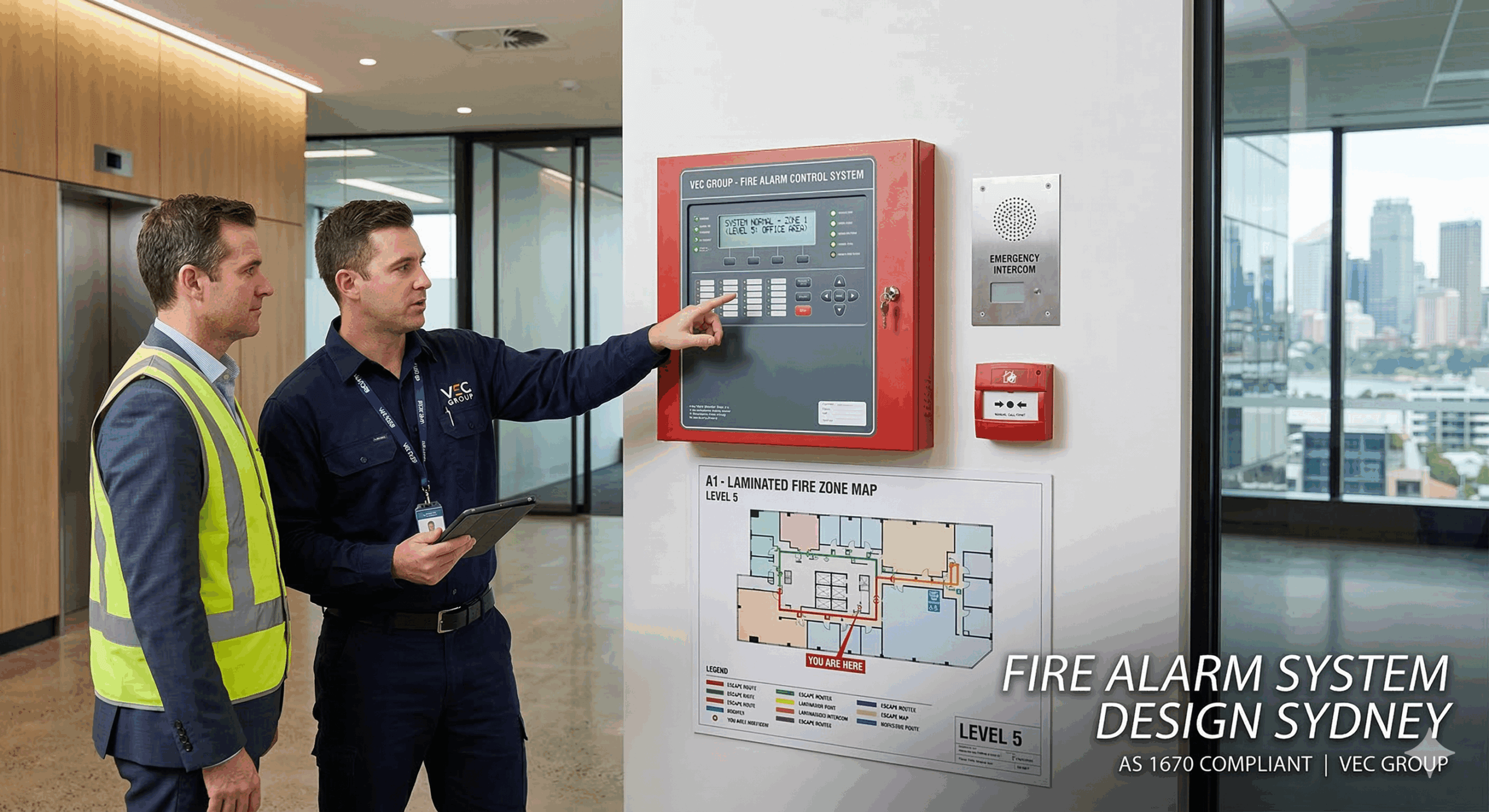
We determine the optimal layout of the Fire Indicator Panel, smoke detectors, manual call points, and EWIS (Emergency Warning and Intercom System).
3. BIM Coordination (MEP and Structural)
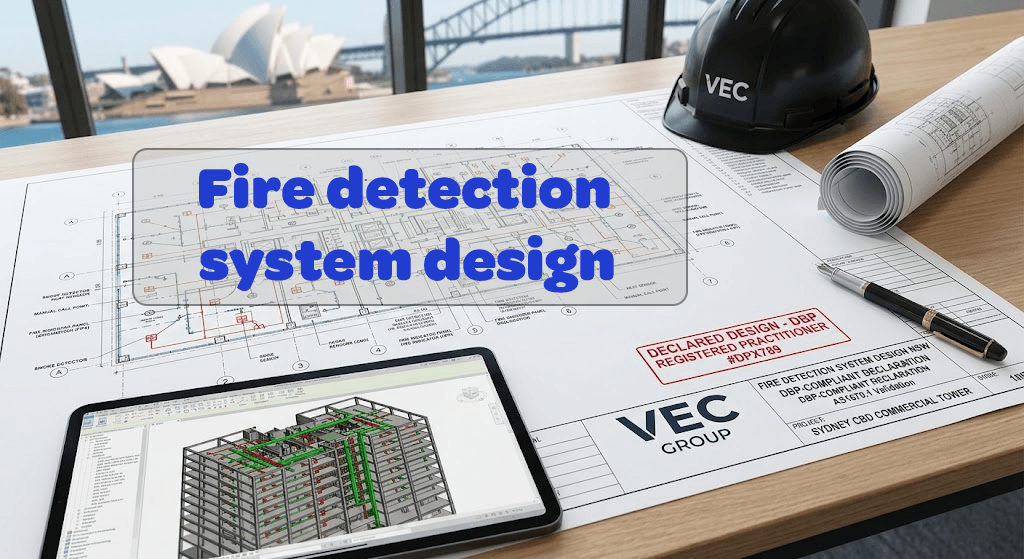
This is where our engineering approach adds the most value. We design your system in 3D using Electrical BIM Modelling (Revit). We overlay the fire detection system with mechanical ductwork, structural beams, and lighting layouts.
This proactive MEP coordination identifies and resolves potential clashes virtually, preventing costly on-site variations during the installation phase. (See the difference detailed shop drawings make in our guide to Electrical Shop Drawings in Construction).
4. Detailed Engineering and AS Validation
Our engineers perform detailed electrical calculations for cable sizing, battery power backup (ensuring the system operates during a blackout), and communication protocols between addressable detectors.
5. Declaration and Certification (DBP Act)
For applicable Class 2 buildings, our DBP Registered Practitioners review and declare the design on the NSW Planning Portal, ensuring your project meets all regulatory milestones for the construction certificate.
Ready to De-Risk Your Next Project?
Don’t gamble on compliance with your life-safety systems. Partner with VEC Group’s Sydney-based DBP-registered fire consulting engineers for a declared, Fire detection system design NSW.
Contact VEC Group today to speak with our engineers about ensuring compliance for your next commercial, residential, or industrial development.