Table of Contents
ToggleIntroduction: Why Dry Fire Protection Systems Matter in Sydney
Sydney’s rapidly evolving commercial landscape demands sophisticated fire protection solutions. Whether you’re managing a state-of-the-art data centre in Parramatta, a heritage-listed building in the CBD, or a sprawling industrial facility in Western Sydney, a dry fire protection system represents the gold standard in fire safety engineering.
Unlike traditional wet pipe sprinkler systems that continuously hold water in pipework, dry fire protection systems use pressurised air or nitrogen to maintain system readiness. When a fire is detected, the pressurised gas is released, allowing water to flow through the pipes and discharge through activated sprinkler heads. This intelligent design prevents water damage, corrosion, and accidental discharge—making it the preferred choice for temperature-sensitive environments, high-value facilities, and buildings where water damage poses a greater risk than fire itself.
In Sydney’s competitive commercial real estate market, investing in a professionally designed and installed dry fire protection system isn’t just about regulatory compliance—it’s about protecting your assets, ensuring occupant safety, and maintaining the long-term viability of your property investment.
Understanding Dry Fire Protection Systems: Technology & Mechanics
What Makes a Dry Fire System Different?
The fundamental difference between wet and dry fire systems lies in how they maintain system readiness:
Wet Fire Systems maintain water continuously in all pipework. While simple and cost-effective, they’re vulnerable to freezing in cold climates, corrosion in coastal environments, and accidental discharge due to pipe ruptures or mechanical failure.
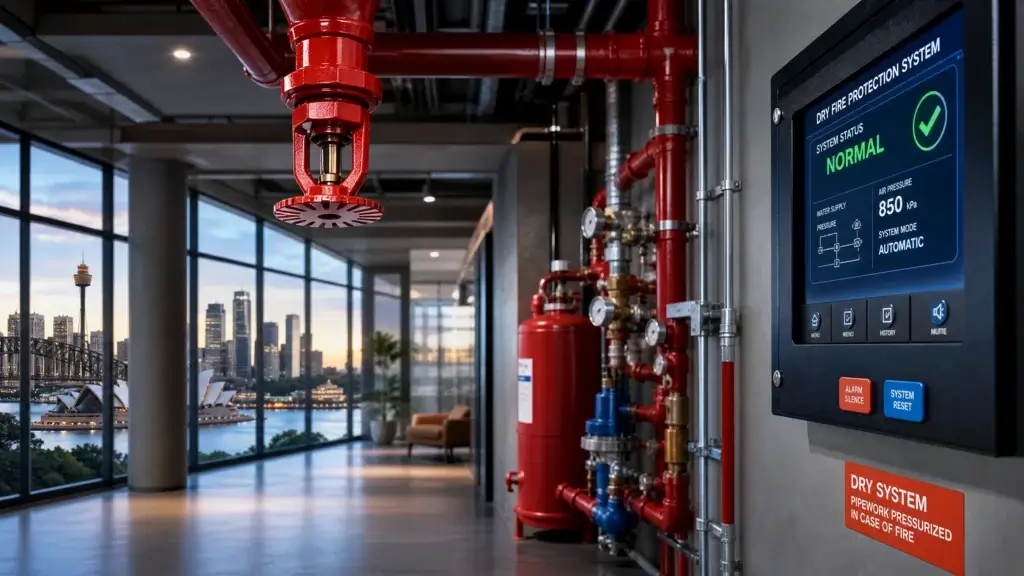
Dry Fire Systems maintain pressurised air or nitrogen in the pipework until a fire is detected. The system architecture includes a sophisticated dry valve assembly that separates the pressurised gas from the water supply. When sprinkler heads activate due to heat exposure, the pressure differential triggers the dry valve, allowing water to flow into the previously empty pipes.
Key Components of a Dry Fire Protection System
A comprehensive dry fire protection system in Sydney typically includes:
|
Component
|
Function
|
Critical Specifications
|
|
Dry Valve Assembly
|
Separates pressurised air from water supply; triggers water flow when sprinklers activate
|
Must meet AS 2118 pressure ratings and response times
|
|
Pressurisation System
|
Maintains air/nitrogen pressure in pipework (typically 0.5-3.5 bar)
|
Requires automatic pressure maintenance and low-pressure alarm
|
|
Sprinkler Heads
|
Activates at specific temperatures (typically 57°C, 68°C, or 79°C)
|
Must be rated for dry system use; different from wet system heads
|
|
Piping Network
|
Distributes water to discharge points; must withstand pressure cycling
|
Steel or copper piping; sized according to AS 2118 hydraulic calculations
|
|
Air Compressor or Nitrogen Supply
|
Maintains system pressure; critical for system reliability
|
Automatic operation with manual backup; regular maintenance essential
|
|
Pressure Gauges & Monitoring
|
Provides real-time system status; alerts to pressure loss
|
Connected to building management systems for continuous monitoring
|
|
Drain & Test Connections
|
Allows system testing and maintenance without full discharge
|
Positioned for safe drainage and testing procedures
|
Australian Standards & Regulatory Compliance
AS 2118: The Foundation Standard
AS 2118 – Automatic Sprinkler Systems is the primary Australian Standard governing the design, installation, commissioning, and maintenance of automatic sprinkler systems, including dry pipe systems. This comprehensive standard addresses:
System design principles and hydraulic calculations
Component selection and performance requirements
Installation procedures and workmanship standards
Testing and commissioning protocols
Maintenance and inspection schedules
For Sydney commercial properties, compliance with AS 2118 is not optional—it’s a legal requirement enforced by local councils, building certifiers, and insurance providers.
NCC 2022/2025 Requirements
The National Construction Code (NCC) specifies when automatic sprinkler systems (including dry fire systems) are mandatory. Key triggers include:
- Class 2 Buildings (apartment buildings): Sprinklers required in common areas, exits, and stairwells
- Class 5 Buildings (offices): Sprinklers required in buildings over 25 metres or with specific fire loads
- Class 6 Buildings (retail): Sprinklers required based on occupancy and fire load calculations
- Class 7 Buildings (car parks): Sprinklers required in multi-storey facilities
- Class 8 Buildings (factories/warehouses): Sprinklers required based on hazard classification
The 2026 update to the NCC introduces stricter requirements for system reliability, maintenance accessibility, and integration with building management systems.
Fire and Rescue NSW Requirements
Fire and Rescue NSW enforces fire safety compliance through:
- Building Code compliance audits
- Annual Fire Safety Statements (AFSS) for commercial buildings
- Mandatory testing and certification of fire systems
- Penalties for non-compliance ranging from $10,000 to $500,000+ for serious breaches
When to Choose a Dry Fire Protection System
Ideal Applications in Sydney
1. Data Centres & Server Rooms
Sydney’s digital economy depends on reliable data infrastructure. Data centres present unique challenges:
Water Sensitivity: Even minor water exposure can destroy expensive server hardware, causing catastrophic business interruption
Continuous Operation: Data centres operate 24/7; any system downtime has massive financial consequences
High-Value Assets: Server equipment represents millions of dollars in capital investment
Solution: Dry fire systems with clean agent suppression (FM-200, Novec 1230) provide fire suppression without water damage. These systems are often combined with advanced detection technologies like VESDA (Very Early Warning Aspirating Smoke Detection) to provide maximum protection with minimal false alarms.
2. High-Rise Residential Buildings (Class 2)
Sydney’s residential towers house thousands of residents. Recent fire incidents have prompted stricter regulations:
Stairwell Protection: Dry systems with pressurisation ensure stairwells remain smoke-free during evacuation
Apartment Protection: Sprinklers in individual units provide early fire suppression
Common Areas: Sprinklers in corridors, lobbies, and communal spaces protect shared infrastructure
Solution: Integrated dry fire systems with smoke management, stairwell pressurisation, and emergency lighting coordination create comprehensive life safety solutions.
3. Industrial Warehouses & Manufacturing Facilities
Western Sydney’s industrial corridor contains numerous high-hazard facilities:
High Ceilings: Traditional sprinkler coverage becomes challenging in facilities with 12+ metre ceilings
Commodity Storage: Different storage configurations (racks, shelves, bulk storage) require customised sprinkler design
Temperature Extremes: Unheated warehouses in winter can freeze water in pipes; dry systems solve this problem
Solution: Dry systems with advanced detection (linear heat detection, beam detectors) and high-pressure discharge nozzles provide effective coverage in challenging environments.
4. Heritage & Historic Buildings
Sydney’s CBD contains numerous heritage-listed buildings with architectural significance:
Aesthetic Concerns: Visible piping and sprinkler heads can damage historic facades
Structural Limitations: Historic structures may not support heavy wet pipe systems
Preservation Requirements: Any modifications must comply with heritage conservation guidelines
Solution: Wireless dry fire systems with discreet detection and concealed piping preserve architectural integrity while ensuring modern fire safety.
5. Cold Storage & Refrigeration Facilities
Sydney’s food distribution network depends on refrigerated storage:
Freezing Risk: Water in pipes freezes in sub-zero environments, rendering wet systems inoperable
Corrosion: Moisture in cold environments accelerates corrosion of metal components
Product Protection: Food products must be protected from water damage
Solution: Dry systems maintain system integrity in extreme cold while protecting valuable inventory.
The Design & Installation Process
Phase 1: Site Assessment & Risk Analysis
Professional dry fire system design begins with comprehensive site evaluation:
Building Survey: Detailed measurements, structural analysis, and identification of potential fire hazards. Our engineers assess ceiling heights, beam configurations, column spacing, and architectural features that affect sprinkler placement.
Fire Load Analysis: Calculation of potential fire intensity based on building contents, occupancy type, and fire compartmentalisation. This determines sprinkler density requirements and spacing.
Environmental Assessment: Temperature ranges, humidity levels, corrosion risk factors, and other environmental conditions that influence system design choices.
Regulatory Review: Verification of applicable standards (AS 2118, NCC, local council requirements) and identification of any special requirements or exemptions.
Stakeholder Consultation: Meetings with building owners, facility managers, tenants, and other stakeholders to understand operational requirements and constraints.
Phase 2: Engineering Design
Based on site assessment findings, our engineers develop detailed system designs:
Hydraulic Calculations: Using industry-standard software, we calculate required water flow rates, pressures, and pipe sizes to ensure adequate coverage throughout the protected area. These calculations account for elevation changes, friction losses, and sprinkler head characteristics.
System Layout: Detailed drawings showing:
- Sprinkler head locations and spacing
- Pipe routing and sizing
- Valve locations and configurations
- Pressure gauge and monitoring point locations
- Drain and test connection locations
- Integration points with other building systems
- Component Selection: Specification of all system components including:
- Dry valve type and rating
- Sprinkler head models and temperature ratings
- Pipe materials and fittings
- Pressure maintenance devices
- Monitoring and alarm systems
- BIM Coordination: Integration of fire system design with architectural, structural, mechanical, and electrical models to identify and resolve conflicts before installation begins.
Phase 3: Installation & Commissioning
Professional installation ensures system reliability and longevity:
Pipe Installation: Experienced technicians install piping according to AS 2118 specifications, ensuring proper support, slope, and protection from damage.
Component Installation: Careful installation of sprinkler heads, valves, gauges, and other components at precisely specified locations.
Pressure Testing: Comprehensive testing of all piping and connections to verify integrity and identify any leaks before system pressurisation.
System Pressurisation: Gradual pressurisation of the system with air or nitrogen, monitoring for any pressure loss that might indicate leaks or defects.
Flow Testing: Activation of test connections to verify water delivery rates and sprinkler discharge patterns match design specifications.
Documentation: Complete commissioning documentation including:
As-built drawings reflecting actual installation
Test certificates and performance data
Operation and maintenance manuals
Warranty documentation
Maintenance & Ongoing Compliance
Annual Inspection Requirements
Under AS 1851-2012, dry fire systems require annual inspection by accredited professionals:
Visual Inspection: Check for corrosion, damage, leaks, or obstruction of sprinkler heads and piping.
Pressure Testing: Verification that system maintains design pressure; investigation of any pressure loss.
Valve Testing: Manual operation of isolation valves and dry valve assembly to ensure proper function.
Alarm Testing: Verification that pressure loss alarms function correctly.
Documentation: Detailed inspection reports documenting findings and any corrective actions required.
Five-Year Maintenance Cycle
Every five years, more comprehensive maintenance is required:
Sprinkler Head Removal & Testing: Sample removal and laboratory testing of sprinkler heads to verify proper operation and absence of corrosion or debris.
Pipe Flushing: Flushing of piping to remove any sediment or corrosion products that might affect sprinkler operation.
Valve Overhaul: Complete disassembly, cleaning, and reassembly of dry valve assemblies to ensure optimal performance.
Pressure Vessel Inspection: For systems using pressurised nitrogen, inspection of pressure vessels for corrosion or damage.
Documentation & Compliance
Maintaining comprehensive documentation is essential:
- Annual inspection certificates
- Test reports and performance data
- Maintenance records and corrective actions
- Spare parts inventory
- Training records for facility staff
- Annual Fire Safety Statements (AFSS) for commercial buildings
Advanced Technologies & Integration
Building Management System Integration
Modern dry fire systems integrate seamlessly with building management systems (BMS):
- Real-Time Monitoring: Continuous monitoring of system pressure, water supply status, and alarm conditions
- Remote Alerts: Immediate notification of any system anomalies via email, SMS, or mobile app
- Historical Data: Logging of system performance data for trend analysis and predictive maintenance
- Integration with Other Systems: Coordination with HVAC systems, emergency lighting, and security systems
Advanced Detection Technologies
Beyond traditional sprinkler systems, advanced detection enhances fire safety:
VESDA (Very Early Warning Aspirating Smoke Detection): Detects smoke particles at concentrations 10-100 times lower than conventional smoke detectors, providing earlier warning of developing fires.
Linear Heat Detection (LHD): Continuous cable-based detection ideal for warehouses and industrial facilities with high ceilings.
Beam Detectors: Infrared beam detectors for detecting smoke in large open areas without obstructing sightlines.
Flame Detectors: Ultraviolet or infrared detection of visible flames, useful in outdoor or partially enclosed spaces.
Smart Pressure Maintenance
Intelligent pressure maintenance systems automatically:
- Maintain optimal system pressure within specified ranges
- Detect slow pressure loss indicating potential leaks
- Provide early warning before pressure drops to unsafe levels
- Reduce false alarms caused by minor pressure fluctuations
Cost-Benefit Analysis: Why Dry Fire Systems Make Financial Sense
Initial Investment vs. Long-Term Savings
While dry fire systems typically cost 15-25% more than wet systems, the financial benefits often justify the investment:
Insurance Premium Reductions: Buildings with certified dry fire systems often qualify for 10-20% reductions in property insurance premiums. For a $10 million commercial property, this can mean $50,000-$100,000 in annual savings.
Asset Protection: For data centres and facilities with high-value contents, the cost of a dry fire system is trivial compared to potential losses from water damage. A single data centre incident could result in losses exceeding $1 million.
Regulatory Compliance: Avoiding fines and penalties for non-compliance is worth far more than the cost of proper system design and installation.
Property Value Enhancement: Commercial properties with certified fire protection systems command premium prices in the market. Studies show 5-10% value premiums for properly protected buildings.
Operational Continuity: Reduced risk of business interruption due to fire damage or false alarms translates to significant financial benefits.
Return on Investment Timeline
For most commercial properties in Sydney, the financial benefits of a dry fire system exceed the initial investment within 5-7 years through insurance savings alone. When combined with asset protection benefits and reduced operational risk, the ROI becomes compelling almost immediately.
Common Challenges & Solutions
Challenge 1: System Reliability in Coastal Environments
Problem: Sydney’s coastal properties face accelerated corrosion from salt air exposure. Traditional steel piping can deteriorate rapidly, compromising system integrity.
Solution: Specify corrosion-resistant materials including:
- Stainless steel piping in coastal zones
- Epoxy-coated carbon steel as alternative
- Copper piping for maximum durability
- Regular inspection and maintenance schedules
- Protective coatings and sealants
Challenge 2: Integration with Historic Architecture
Problem: Heritage buildings require fire protection without compromising architectural integrity or historic fabric.
Solution: Implement concealed systems including:
- Wireless detection systems eliminating visible wiring
- Piping routed through walls and concealed spaces
- Discreet sprinkler heads designed to blend with ceilings
- Custom valve enclosures matching historic aesthetics
- Professional coordination with heritage conservation specialists
Challenge 3: Pressure Maintenance in Extreme Temperatures
Problem: Sydney’s temperature variations (from near-freezing in winter to 40°C+ in summer) create challenges for maintaining stable system pressure.
- Solution: Deploy intelligent pressure maintenance including:
- Automatic pressure regulators with temperature compensation
- Nitrogen systems (more stable than compressed air)
- Redundant pressure maintenance devices
- Continuous monitoring with alert thresholds
- Regular maintenance and pressure vessel inspection
Challenge 4: False Alarm Reduction
Problem: Overly sensitive detection systems trigger false alarms, causing costly emergency responses and occupant disruption.
Solution: Implement multi-stage detection including:
- Dual-sensor detectors (smoke + heat) requiring both to trigger alarm
- VESDA systems with sophisticated analysis algorithms
- Integration with building management systems for verification
- Regular cleaning and maintenance of detection devices
Staff training on proper system operation
Frequently Asked Questions
Q: What’s the difference between a dry pipe system and a pre-action system?
A: While both protect against accidental discharge, they operate differently. Dry pipe systems use pressurised air/nitrogen to hold back water; when sprinklers activate, pressure is released and water flows. Pre-action systems require two independent triggers (typically a heat detector AND a sprinkler head) before water is released. Pre-action systems offer additional protection against accidental discharge but are more complex and expensive. For most Sydney applications, dry pipe systems provide optimal balance of protection and cost-effectiveness.
Q: How often must dry fire systems be inspected?
A: Under AS 1851-2012, annual inspections by accredited professionals are mandatory. Additionally, more comprehensive maintenance is required every five years. Building owners must maintain detailed inspection records and submit Annual Fire Safety Statements (AFSS) to local councils.
Q: Can dry fire systems be retrofitted to existing buildings?
A: Yes, but retrofitting presents challenges. Existing structural elements may not accommodate new piping, and aesthetic concerns in heritage or premium buildings require creative solutions. Wireless systems and concealed routing can overcome many obstacles. Professional assessment is essential to determine feasibility and cost.
Q: What’s the typical lifespan of a dry fire system?
A: With proper maintenance, dry fire systems typically last 25-40 years. However, individual components may require replacement:
- Sprinkler heads: 20-30 years
- Dry valve assemblies: 15-25 years
- Piping: 30-50 years depending on material and environment
- Pressure maintenance devices: 10-15 years
- Regular maintenance extends component lifespan and ensures system reliability.
Q: How much does a dry fire protection system cost?
A: Costs vary significantly based on building size, complexity, and specific requirements. Typical costs range from $50-$150 per square metre for design and installation. A 5,000 m² commercial building might cost $250,000-$750,000. Obtain detailed quotes from multiple qualified contractors to ensure competitive pricing.
Q: Are there any buildings exempt from fire system requirements?
A: Some small buildings may be exempt based on NCC classifications and size thresholds. However, most commercial buildings in Sydney require some level of fire protection. Consult with a building certifier or fire safety engineer to determine specific requirements for your property.
Conclusion: Protecting Sydney’s Future
Sydney’s commercial landscape continues to evolve, with increasingly sophisticated buildings requiring equally sophisticated fire protection solutions. Dry fire protection systems represent the modern standard in fire safety engineering—combining advanced technology, regulatory compliance, and asset protection in a single integrated solution.
Whether you’re developing a new commercial tower, retrofitting a heritage building, or upgrading an existing facility, a professionally designed and installed dry fire protection system is an investment in safety, compliance, and long-term property value.
The question isn’t whether you can afford a dry fire protection system—it’s whether you can afford not to have one.
Get Your Free Consultation Today
Don’t leave your fire safety to chance. Our team of accredited fire protection engineers is ready to assess your specific needs and develop a customised solution that meets all applicable standards while protecting your assets and occupants.
Contact us today for a free consultation:
- Phone: 0406 039 661
- Email: info@vecgroup.com.au