Table of Contents
ToggleLighting Compliance NSW: 7 Essential Steps for Project Approval
Lighting compliance in New South Wales is a multi-layered requirement that affects commercial buildings, industrial facilities, public spaces, residential developments and workplace environments. Whether you are upgrading an existing facility, designing a new building or managing a development application, understanding the lighting compliance framework is essential to avoid delays, failed approvals and safety risks.
In NSW, lighting compliance is governed by the National Construction Code (NCC), Australian and New Zealand Standards, SafeWork NSW requirements, and local council planning controls. Each project type and building classification has its own compliance pathway, and failing to identify the correct requirements early can result in costly redesigns, occupancy certificate delays or safety incidents.
This guide outlines the seven essential steps to ensure your lighting design, installation and operation meet all applicable NSW requirements.
Step 1: Confirm the Project and Approval Pathway
The first step in lighting compliance is understanding your project’s classification and approval pathway. Building classification determines which sections of the National Construction Code apply to your project. The NCC defines classes ranging from Class 1 (single dwellings) through Class 9 (other buildings such as warehouses and storage facilities). Your building class directly affects which lighting standards and energy-efficiency requirements apply.
Additionally, determine whether your project requires development consent, a complying development certificate, or falls under exempt development. Development consent conditions often include specific lighting requirements, such as compliance with AS/NZS 4282 for external lighting or restrictions on light spill affecting neighbouring properties. Understanding your approval pathway early allows you to incorporate compliance requirements into the design phase rather than attempting remediation later.
Step 2: Identify Applicable Standards and Requirements
Once your project classification is confirmed, identify all applicable standards and regulatory requirements. The primary framework includes the [National Construction Code (NCC) Part J7 for artificial lighting and power][1], which sets energy-efficiency limits for Classes 3–9 buildings. The NCC specifies maximum illumination power density (watts per square metre) for different space types, and compliance is typically verified through detailed lighting calculations and documentation.
For workplace environments, [SafeWork NSW requires that lighting enable workers to perform their tasks safely, move around the workplace without risk, and evacuate safely in an emergency][2]. A competent person—typically a licensed electrician or lighting engineer—should determine appropriate illumination levels (measured in lux) in accordance with the relevant Australian Standard.
The AS/NZS 1680 series provides guidelines for general lighting requirements, while the AS/NZS 2293 series covers emergency lighting. For external lighting projects, AS/NZS 4282:2023 addresses the control of obtrusive effects of outdoor lighting, including light spill, glare and sky glow. Many NSW councils incorporate AS/NZS 4282 into development consent conditions, making compliance essential for approval.
Step 3: Assess Workplace Safety and Emergency Egress
Workplace lighting safety is a fundamental compliance requirement. Poor lighting can lead to slips, trips, falls, eyestrain, headaches and reduced productivity. Conversely, excessive lighting can cause migraines, fatigue and disruption to circadian rhythms. The goal is to achieve balanced, appropriate illumination for the task and environment.
[SafeWork NSW specifies that emergency lighting must enable safe evacuation during power outages][2]. Emergency lights are battery-backed devices that activate automatically when power fails, providing adequate illumination for occupants to exit the building safely. Emergency exit signs must be clearly visible and illuminated at all times. Regular inspection, testing and maintenance of emergency lighting systems are essential and should be performed by a licensed electrician.
Step 4: Consider Energy Efficiency and Lighting Controls
Energy efficiency is a core compliance requirement under the NCC. [Part J7 of the NCC 2022 sets strict limits on illumination power density, which is the total wattage of lighting divided by the area served][1]. The allowable power density varies by space type—for example, office areas have different limits than storage areas or circulation spaces.
To achieve compliance, consider LED luminaires, which offer superior energy efficiency compared to older technologies. Implement smart controls such as occupancy sensors, daylight harvesting systems, and dimming controls. These reduce energy consumption by ensuring lights operate only when needed and at appropriate intensity levels. Proper control strategy design not only meets NCC requirements but also reduces operational costs and environmental impact.
Step 5: Model and Manage External Impacts
External lighting projects require careful assessment of light spill, glare and impacts on neighbouring properties. AS/NZS 4282:2023 establishes limits on light trespass, glare and sky glow. Many NSW councils require compliance with this standard as a condition of development consent, particularly for car parks, commercial precincts, sports fields and residential developments.
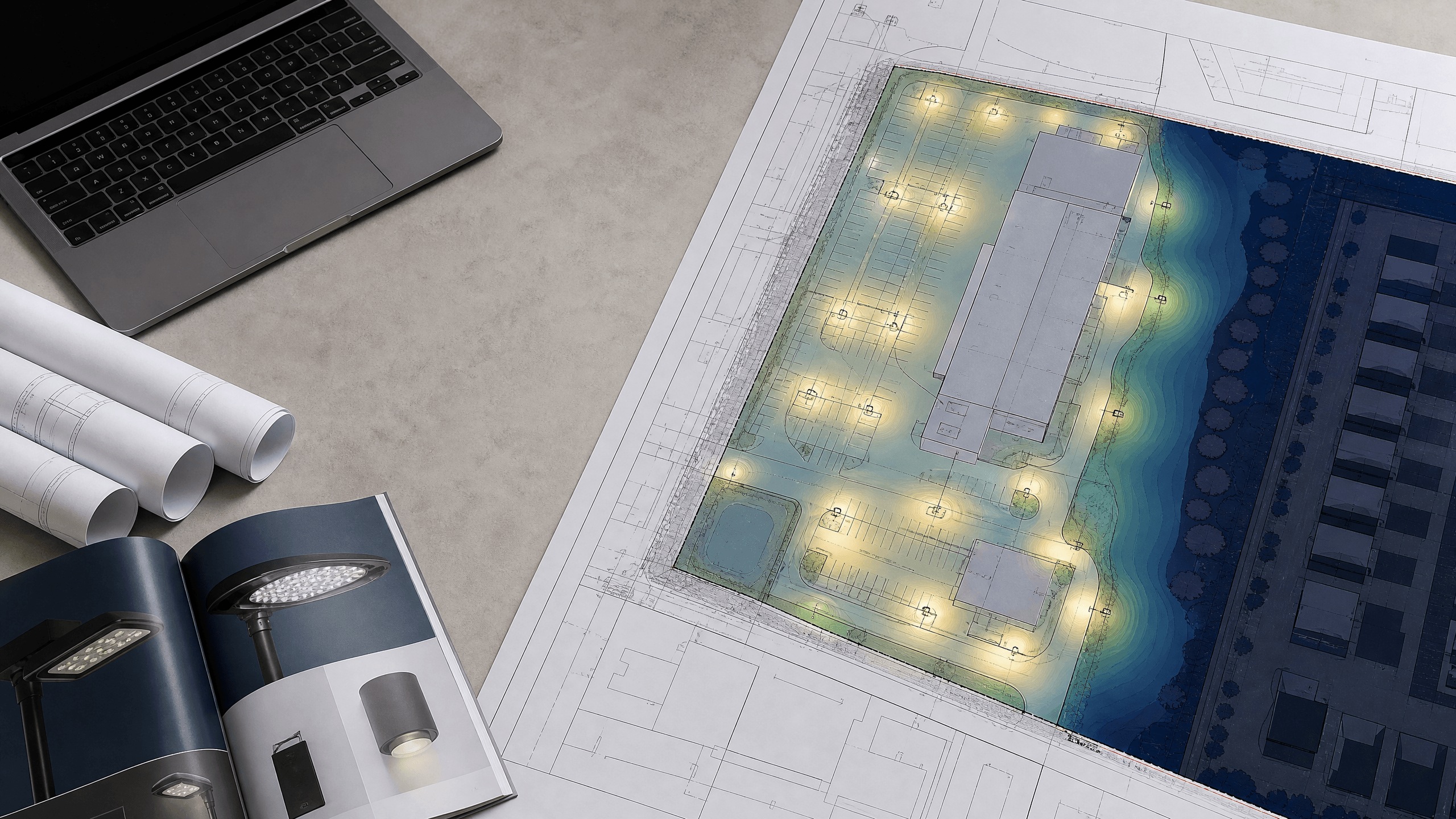
Professional photometric modelling using specialised software allows engineers to calculate illumination levels, verify light spill and glare, and confirm compliance before construction. This approach identifies potential issues early and avoids costly site modifications. When designing external lighting, select full cut-off luminaires that direct light downward, minimise upward light, and control glare through appropriate shielding and aiming. The external lighting design guide explains the design process, while the light spill assessment guide addresses the evidence needed when external effects require closer review.
Step 6: Produce Coordinated Documentation
Comprehensive documentation is essential for demonstrating compliance and supporting installation. Required deliverables typically include detailed lighting design drawings showing luminaire positions and mounting heights, a complete luminaire and electrical schedule, calculation reports proving compliance with relevant standards, control schematics showing switching and dimming zones, NCC Section J compliance reports, and an operation and maintenance manual.
Coordinated documentation minimises installation errors, supports future maintenance, and provides a clear record of design decisions. This documentation is typically required by councils, certifiers and building owners before occupancy certificates are issued.
Step 7: Commission, Verify, Maintain and Record
On-site commissioning is the final step in ensuring compliance. Activities include pre-commissioning inspection, electrical testing, photometric verification (measuring illumination levels and comparing to design), control system testing, and glare and light-spill assessment. A commissioning report documenting all tests, measurements and final performance confirms that the system operates as designed and meets all compliance requirements.
Ongoing maintenance is critical. Regular inspection, testing and maintenance of lighting installations—particularly emergency lighting—must be performed by a licensed electrician. Maintain detailed records of all inspections, tests and maintenance activities to demonstrate ongoing compliance and support future upgrades.
Common Compliance Pitfalls to Avoid
Several common mistakes can derail lighting compliance. Over-lighting wastes energy and violates NCC limits. Neglecting controls means systems operate at full intensity continuously, increasing costs and environmental impact. Poor luminaire selection based on price alone often results in non-compliance. Inadequate site surveys lead to designs that do not fit the site or fail to account for existing conditions. Ignoring council requirements and development consent conditions results in approval delays or rejection. Poor coordination with other building services (mechanical, electrical, fire) creates conflicts and cost overruns. Inadequate documentation complicates maintenance and future upgrades. Finally, skipping commissioning often leads to operational problems and safety risks.
When to Engage a Professional
Complex projects, regulatory compliance requirements, high-value installations and performance guarantees all warrant engagement of a professional lighting engineer. [Professional lighting design consultants bring expertise in Australian Standards, NSW council requirements, photometric modelling and commissioning. They can identify compliance risks early, design efficient systems and provide documentation supporting approvals.
For lighting compliance projects in NSW, Vec Group’s Lighting Engineering service brings deep expertise in NCC requirements, Australian Standards and council controls. Our team has delivered external lighting design guides and AS/NZS 4282 compliance assessments across NSW and is ready to support your project.
Conclusion
Lighting compliance in NSW requires a systematic approach that addresses safety, energy efficiency, external impacts and regulatory requirements. By following these seven essential steps—confirming your approval pathway, identifying applicable standards, assessing safety, considering energy efficiency, managing external impacts, producing documentation and commissioning the system—you can ensure your lighting design and installation meet all requirements and support project approval.
If you are planning a lighting compliance project in NSW, contact Vec Group today for expert guidance and professional lighting engineering solutions.